


Feeling safe is as important to a cat's health and well-being as food or play. But cats don't show stress the way we do. Some go quiet, hide,start stress-peeing and so on. My cat, Luna, is very anxious and also the biggest purring machine I’ve ever met. And as she ages she purrs almost all the time to self-soothe.
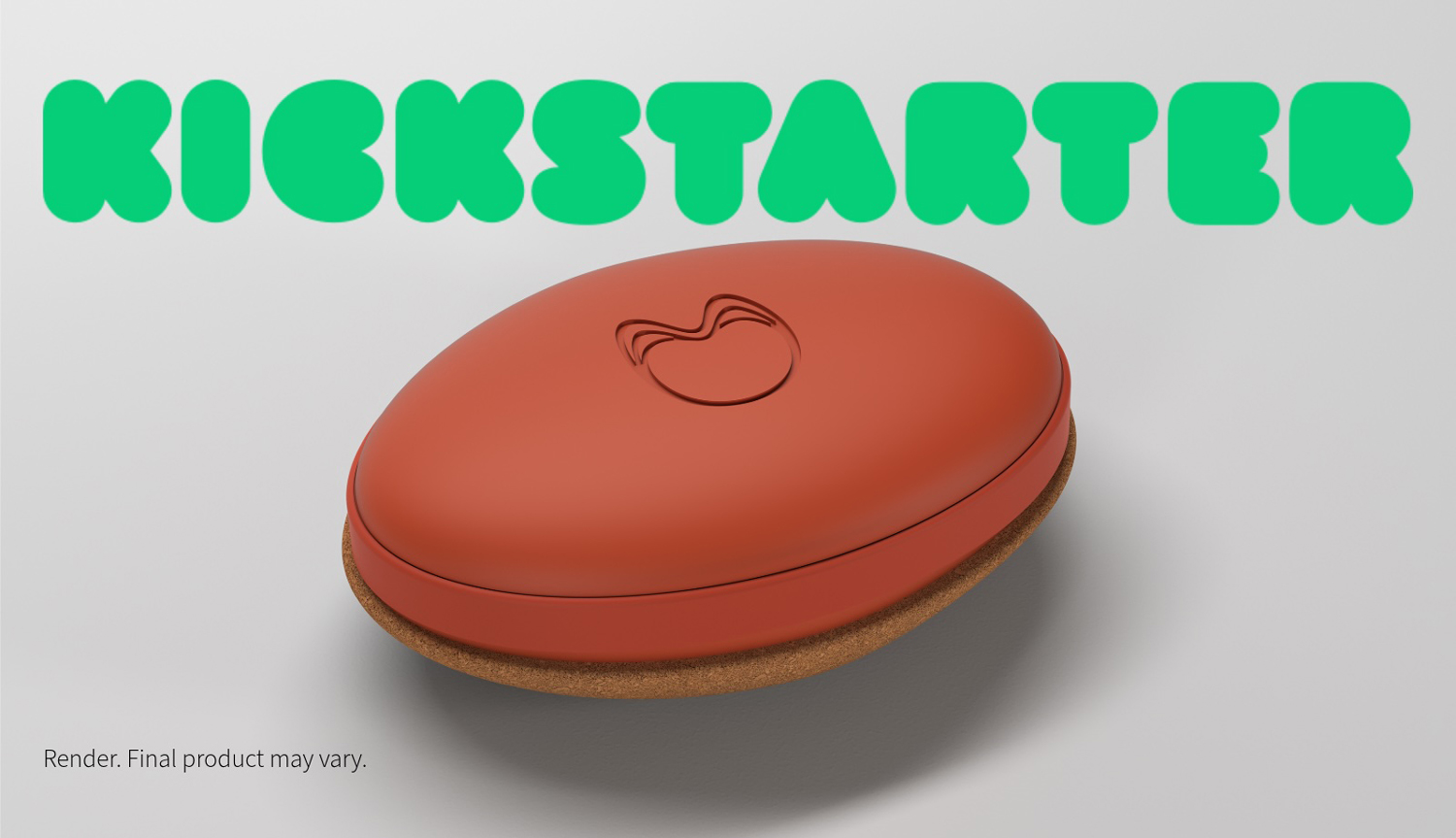
There are many people like you reading this that are trying to find calming solutions. Gemma and Roy, co-founders of Purrwave, have created a Kickstarter for a speaker that calms cats through purrs that I think is a fantastic solution for people with anxious cats.
I sat down with Gemma to learn more about their journey creating the Purrwave, which is one of the most simple yet clever tech products I’ve seen, to find out more about their innovative product and Kickstarter.
CHECK OUT THE KICKSTARTER HERE
Ends Thursday, October 8, 2026
Tell us a bit about yourselves, your cats, and how the two of you ended up building Purrwave together.
I’m Gemma, and I first came up with the idea of Purrwave when my beautiful old cat Frankie became sick, last year. I’d always loved the way he purred for me when I was sick, so I wanted to do the same for him. I started playing a purr track super-quietly on a Bluetooth speaker, and he loved it – he’d lie with his head on the speaker, and when we were cuddling I think it helped us bond. When we went to the vet, which happened a lot in January, he always howled in his carrier. I started playing a purr into his carrier with my phone and he instantly stopped miaowing and calmed down. He died in January, and I was devastated, but I very soon found myself fostering a little cat in need, Lou Lou – who is a foster fail! – and she was so terrified she just hid under the wardrobe or the bed for days. I thought: let’s give this purr thing a go – and pretty soon she was curled up next to the speaker on the bed. I thought: maybe there’s something in this.
Phone footage of Frankie enjoying a purr played on a Bluetooth speaker in 2025
When I was pondering it, I was at the home of my friends Bea and Roy, who I’ve known for 30 years. We tried playing a purr to their cat Xula, and she just flopped down next to the speaker and stretched out. Roy was taking a break from his career as a corporate lawyer, and I mentioned it to him, and he instantly saw it as something he’d like to work on with me. Our skills really complement one another. I’m very much a creative – a former fashion journalist, a copywriter, and a jeweller – but it’s Roy that has the attention to detail and business chops to really make this more than just another great idea! And of course we’re both huge cat lovers.
Phone footage of Xula enjoying the sound and vibration of a Purrwave prototype in 2026
Can you share more about the story behind Purrwave? What was it about playing a purr to your cats that first showed you this could actually work?
When we started working on this, we knew it had an effect on our cats, but we really needed to check it wasn’t just our wishful thinking. So I bought some cheap little MP3 players, loaded them with purrs, and sent them out for people to try out. The results were great – particularly from the small cat shelter and a cat-foster parent, who saw really promising results. That was when we decided to go ahead and work with a product designer to develop a prototype. We spoke to a few larger businesses but ended up working with Jon Fidler, of Modla Studios. He’s pretty much a one-man band but he’s worked on some incredible products, including his own wildlife-led Kickstarter, and he has cats and a rabbit too! He’s local and he’s full of energy and ideas.
You've been upfront that the peer-reviewed science on purrs is still limited. How did you get comfortable building a product on evidence that's promising but not settled?
It’s a tough one - especially with a lawyer as a partner making sure I don’t blurt out something we can’t support! But if we waited till all the scientific evidence was there, we’d never make anything! So we’ve been really transparent about it. There’s enough snake oil out there.
We’ve tested with people’s cats at every stage, and while this is not controlled testing at this stage, we’ve seen powerful enough results from a broad enough sample that we feel happy that we’re creating something that can really help cats. We think the research around purrs, while limited, does show some clear patterns backed up by what cat owners themselves observe. We’re also hugely encouraged by the responses from animal professionals, some of whom already use purrs in their practice – my vet who dealt with Frankie was really excited by this. We’ve also trialled it with people like a clinical cat behaviourist who saw a clear benefit with her cat, and a cat groomer who uses purrs already, but also benefits using the Purrwave – and both have had useful feedback and suggestions to make it even better.
I think it’s important to recognise that cats are complex, sentient creatures, and their stress can be for all sorts of reasons. This isn’t going to cure those reasons, but it is another weapon in the cat-calming arsenal, and one that people have found effective so far. The most important thing of all is to ensure that no cats dislike this product – we actually found that some cats really don’t like the 'solicitation purr’ which has a higher-frequency note that seems to be specifically developed to manipulate humans!
When we use the ‘best’ purrs we’ve found so far, no cats have reacted negatively, but already chilled cats have been described as indifferent – they’ve had a sniff then wandered a few feet away and groomed or slept. We actually see that as a positive reaction, because no cat will sit near a sound or feeling they dislike! We’re making an assumption on this, of course, but the best way I would describe it is as like playing relaxing music in the background.
But all of that said, we’re committed to doing controlled testing to find the most effective purrs before we release the final product, and if we end up doing well as a business, we’d love to be able to help with more rigorous research on purring.
Purrwave uses an electroacoustic transducer rather than a normal speaker cone. In plain terms, what does that change about how it feels rather than how it sounds?
In really plain terms, it vibrates rather than just makes sound, so it not only sounds but feels just like a purr. When we started looking into how a cat actually purrs, we realised the way they get this very low frequency – 25-150Hz – even though they’re small animals is by vibrating dense pads of tissue in their larynx. And of course when you sit next to a purring cat you can actively feel the vibration. A normal speaker doesn’t replicate that, and it’s really hard to eliminate the higher frequencies. The closest technology we could find to replicate that was the electroacoustic transducer, otherwise known as an exciter, in which the sound is made from the vibration on a solid surface.
There are a couple of really cool things about this. First, of course, is that you can have a really quiet sound that feels like a real purr. Even loud cats actually purr quite quietly, and their hearing is remarkable, so even at its lowest volume we found a Bluetooth speaker too loud. Also if a cat is in a noisy environment – just the sort of situation that would stress them – they can feel the purr through whatever surface they’re sitting on – whether that’s a cat carrier, a cat bed, a sofa…
Then there’s one fun element which is that the sound is subtly altered by different substrates – so if we put the Purrwave on a flat cork mat it sounds different to a wooden base. I’m playing it on a sofa right now and it actually amplifies the sound as it vibrates through the cushions, so I have it at its quietest. And if you play it on a hollow object, such as a cabinet, a box or an upturned bowl, you get more volume too. So you can really customise the tone.
A recorded purr and a real purr aren't the same thing to a cat. What went into the sound design, and how far off were the early prototypes?
Well what’s interesting is that we started from a good place – even playing a purr through an iPhone had a noticeable effect on my cat Frankie. Using a speaker worked too. But we knew that this would have limits in different environments, and I felt there was still a dimension we were missing, which was the vibration. So Jon suggested adding an exciter, but through the prototyping we realised that not only was the traditional speaker component unnecessary but removing it also allowed us to miniaturise the product – and that was a really important aim with the design, so it can go in a carrier, a pocket, a cat bed, or just sit unobtrusively on a shelf.
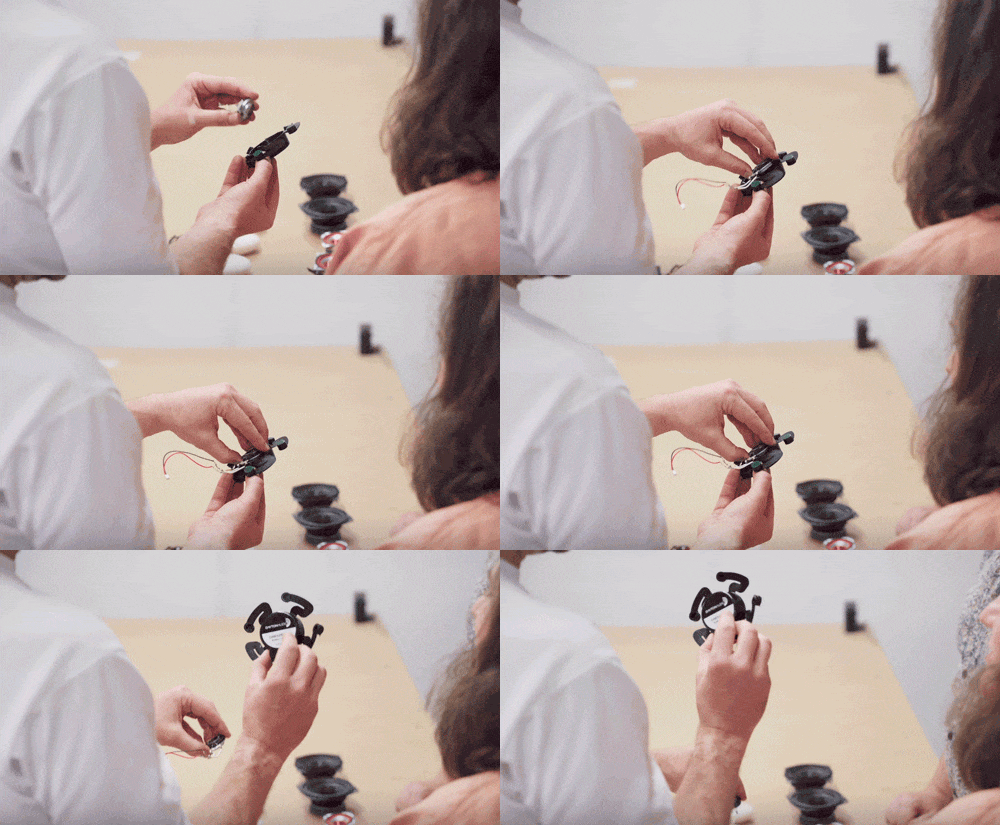
If we hit our Kickstarter target we’ll go into a sound-engineering sprint to work out the cleanest way to record and process a purr track (it’s not like you can put a cat in a sound booth and expect it to purr!), find the most calming purrs for cats, work out the best internal substrate for the exciter, as well as any alterations to the shape that might affect the acoustics.
Testing a product on a customer who can't tell you what they think sounds hard. How did you work out that Lou Lou and Xula were actually calmer, and not just tolerating it?
That’s a really important point, and the hardest thing to validate. With Frankie, there was an immediate calming, and when I left the speaker on the bed, he put his head right on it. With Lou Lou, again, I left the speaker on the bed while she was hiding under the bed, and she actively came out from under the bed to sleep next to the speaker. Xula went right up to it and started purring and put her tummy in the air. The cat behaviourist’s cat, who’d had some stressful vet visits, sniffed it cautiously then lay down near it on the bed and started grooming. I think, in general, cats don’t just tolerate things they don’t like. They either walk away or attack it – and when we played the solicitation purr, Xula started attacking the speaker! That’s why we’re fairly confident that even the cats who appeared indifferent were probably enjoying it rather than tolerating it.
Nowadays, Lou Lou doesn’t show a distinct reaction to it because she’s used to it, but she is more inclined to curl up and go to sleep, and when I switch it off to go to bed, she wakes up with a little start and chirrup!
You had an animal behaviourist and a cat groomer try the prototype. What did they observe when they tried it that you didn't expect?
The behaviourist gave us really clear feedback. Her cat Hugo reacted really well to it, but she also noted that there was a slightly-too-loud purr as part of the cycle we had programmed, which she suggested might startle cats. She said Hugo first used scent to explore it, which I think gives us a good behavioural cue for introducing cats to the Purrwave, and she also suggested that using the same purr in a vet might cause a negative association. I didn’t find that with Frankie, but we’re putting at least three purrs on the device, so people could perhaps choose to use different purrs for relaxing at home and at the vet.
The cat groomer’s first experience was really good – he was taking the Purrwave to home visits, and he found that the owners were also really relaxed by it – which probably, in turn, helped relax cats even more! He did think it was less effective when there were multiple cats together, which could make sense – they probably soothe each other. But then when cats from a multi-cat household are alone, at the vet for example, I would hypothesise that a purr would be even more comforting to them. We’d love to test this at some point.
I want to be careful not to suggest that tech replaces proper care. Where does Purrwave sit alongside veterinary advice for a genuinely anxious cat?
Yes, we are extremely careful to say this in the Kickstarter story. This is not a therapeutic device in the medical sense. We make no medical claims. This is a calming device that can benefit cats who are stressed for various reasons, whether that’s going to the vet, recovery after surgery, being home alone, travelling, or just being hyperactive after play! Vets and vet nurses we’ve spoken to agree that this has the potential to help cats remain calm, but it is not a substitute for veterinary care.
Who do you think would benefit the most from supporting the Kickstarter and buying a Purrwave?
We think any cat owner would benefit, because even the calmest cat will sometimes end up at the vet, but we especially see it helping people with more highly strung cats, indoor-only cats that get left home alone, cats that suffer stress when they go in a carrier, rescue cats, elderly cats, kittens… We also have a ‘Shelter set’ of five on the Rewards, which has a good discount, and we’ve had one backer buy this for a shelter of our choice – it’s going to the shelter that we first tested with. One vet nurse suggested it would be especially good for hand-rears, and another said it would be great for rehoming elderly cats! Oh how do I narrow it down? Plus we had hundreds of cat owners try a prototype at an event recently, and almost every one of them said they found it incredibly relaxing, so even if the cat is indifferent, humans love it. (Again, we make no therapeutic claims!)
Are there cats you'd expect Purrwave not to work for, and how do you plan to set expectations around that?
Let’s face it, all cats are different and unique personalities, so it’s very hard to predict. But I’d say that there have been cats that have seemed unbothered by it – they’ve sniffed it and sat near it grooming, but not in a dramatic way! These have largely been very chilled cats, so it’s to be expected that they might have a less strong reaction. Saying that, Xula is a really confident and happy cat, and she loves it!
We’re going to consult with Amanda Campion, the cat behaviourist, to work out some behavioural advice on how to introduce the cat and what to expect as they engage with it. I’ve been there when a tester put the Purrwave down directly in front of a cat and then stood over him to see what happened – not the most conducive conditions for a cat to get used to something new!
Many of my readers try to make cat tech blend in with their home. Talk me through the case design, the cork stand, and the color that came from Frankie's nose.
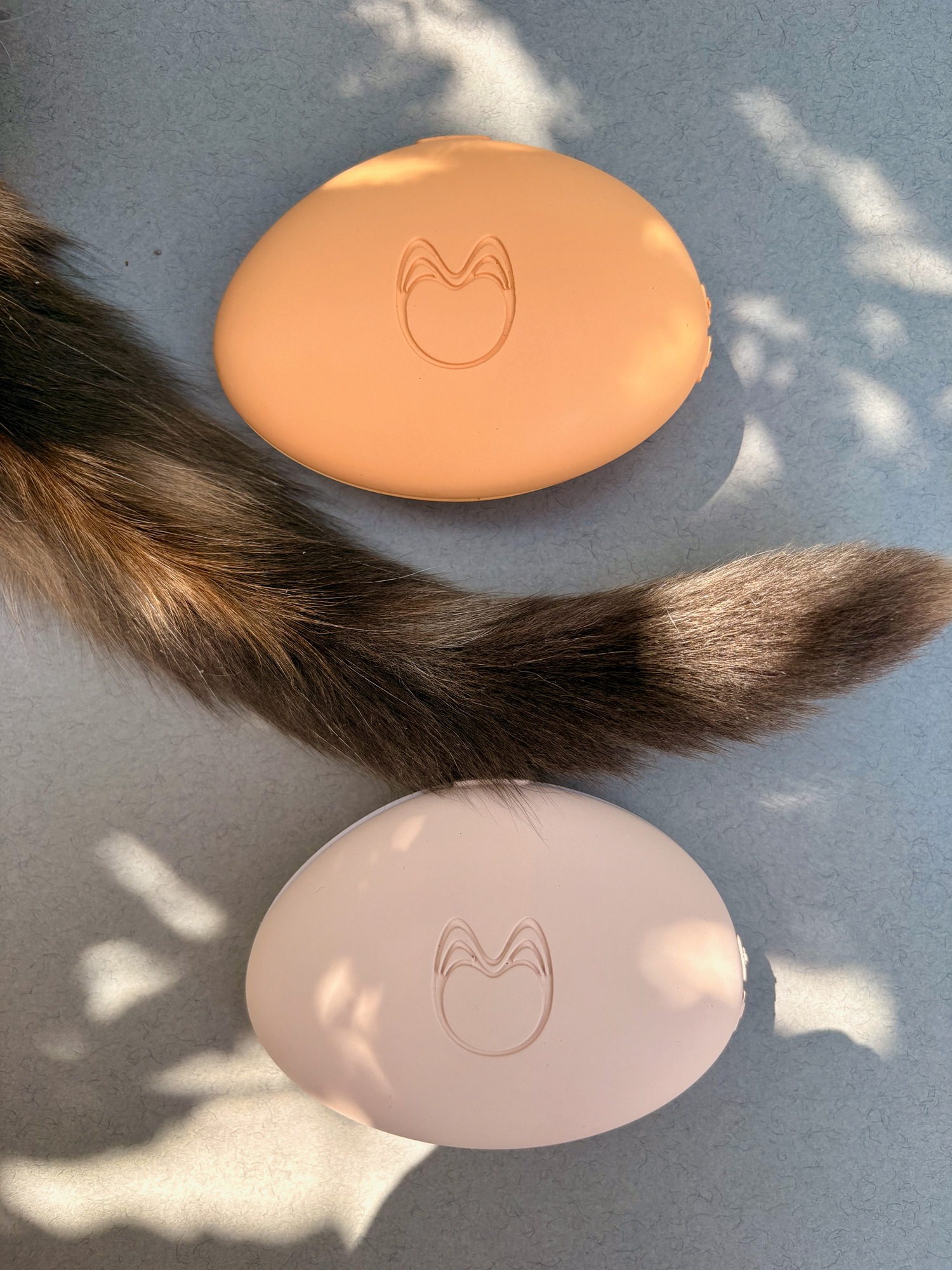
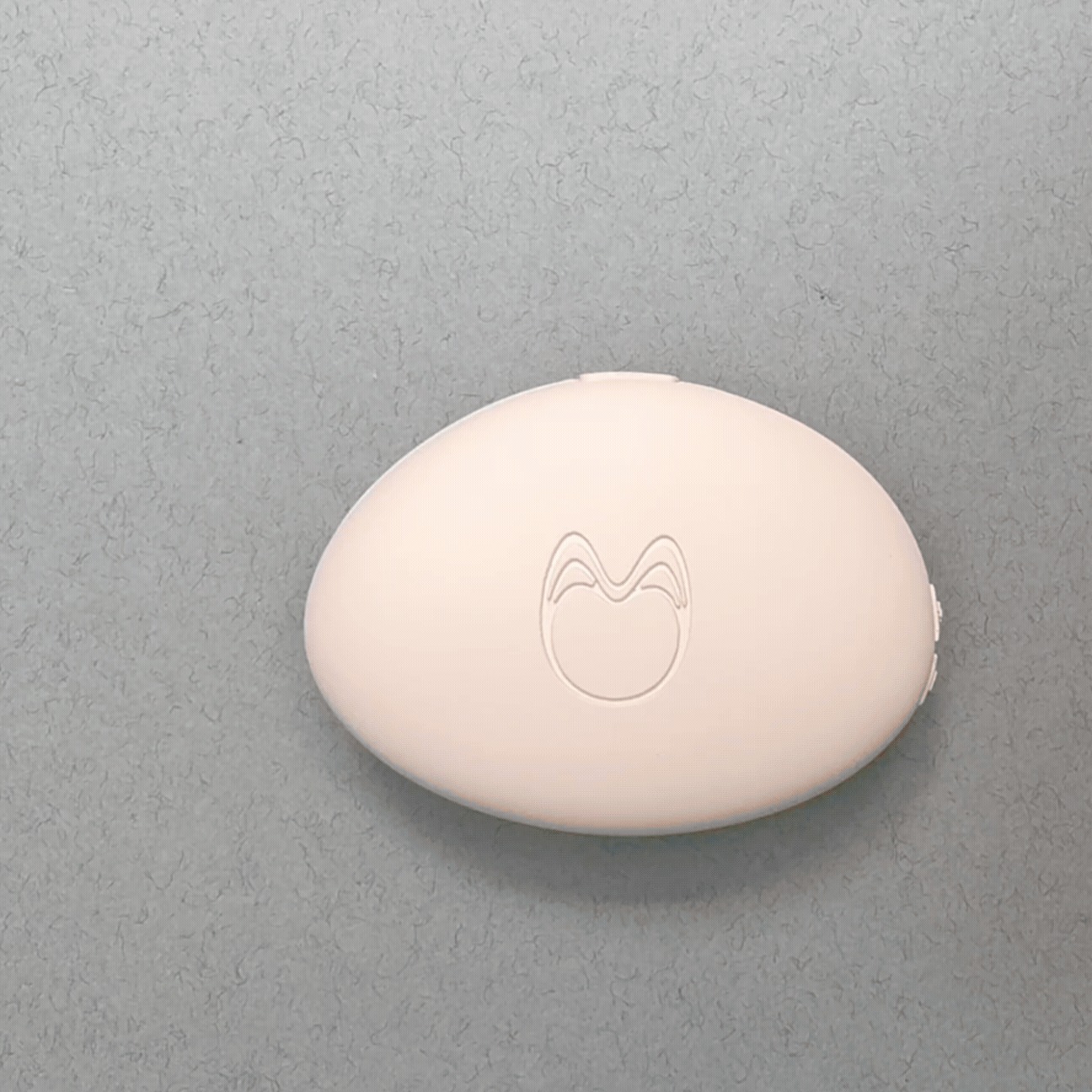
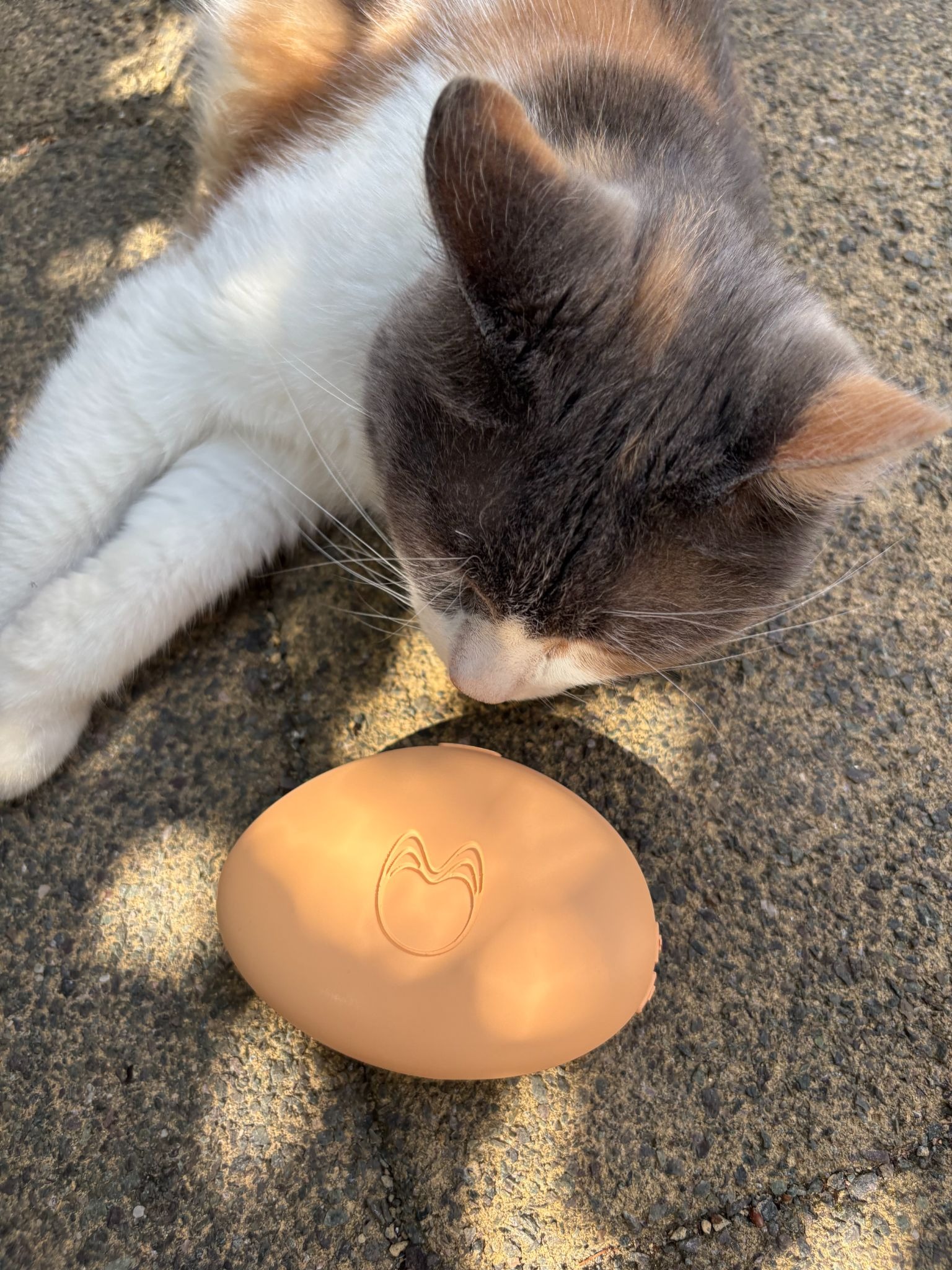
We’re really conscious of making this into a really beautiful product. The prototype is a bit rough-and-ready-looking because it’s 3D printed, but it will be a beautiful smooth injection-moulded finish. We needed it to be small, smooth, with no awkward corners, easy to clean and watertight. At the moment we’re going for a pebble shape – a lovely organic shape to handle that speaks of tranquility. There may be some adjustments when we go into sound design, but it will remain small, smooth and beautiful. The cork Sound Stand that comes with it provides a lovely non-synthetic substrate that warms the sound, but you can take it off and turn it upside down, creating a stand that also amplifies the sound somewhat. We’re hoping to create other Sound Stands in natural materials like wood, wool felt, maybe even ceramic, and potentially a small bag so you can wear it next to you while you’re cuddling the cat, helping them associate the purr with their person.
In terms of the colour, we wanted a warm, organic shade for the first batch, and this sort of terracotta colour, which is the colour of my elderly cat Frankie’s nose, felt right. It’s only cost-effective to do one colour for the first batch, but if we get beyond the target, we may open up other colour options from the brand colours (which are based on my current cat Lou Lou, a dilute tortie!).
Walk us through the materials, such as the bio-based plastic, cork, and sustainable packaging. Where did sustainability shape the decision, and where did you have to compromise?
Our material choices aren’t finalised because again the acoustics could affect our choices. Because it is injection moulded we have to use a plastic of some sort – it’s also easy to clean, light and affordable. But no one wants to put more plastic than necessary into the world. So we’ll be choosing the specific bioplastic based on the best balance of recyclability and minimising fossil fuels.
Currently bioplastics can be recycled industrially, so each component will have a recycling instruction on it, and we hope to work with an electronics recycling charity to provide clear guidance on what to do with a Purrwave at the end of its life. That includes recycling the lithium battery responsibly and safely, and the circuit boards. If we reach sufficient scale, our ambition is to introduce a circular recycling system, but that’s not possible right now. All the other elements we are choosing will be non-plastic as far as possible.
Our packaging will be sustainable cardboard with uncoated paper inserts, and a plastic-free cloth bag. It will all feel premium, but there’s no real excuse for plastic packaging nowadays.
We’re also hoping to get them manufactured mostly in the UK to reduce carbon miles. Our electronics are being designed by Arribada, which is an open-source wildlife electronics specialist – they do things like turtle tags. We will follow their recommendation for electronics manufacture.
There's no app, no subscription, and nothing to pair. That's the opposite of most pet tech. Can you tell me more about why you chose this direction?
I think we’re all exhausted with subscriptions, especially with pet tech. From your food to your GPS tracker, every time you buy something you have to download an app and sign up for a monthly subscription. We’re over it! Just switch it on, play it, recharge it, play it, recharge it… That’s it! Yes we could probably make more money with a subscription. But that’s really not what we’re about.
What's the user experience like for Purrwave regarding the battery-life, charging, and turning it on and off?
We’re making it as simple as possible. The buttons are all covered with a bio-silicone band so it’s watertight. There’s currently an on-off button, and then plus-minus buttons that work for the different purr options, the volume, and setting an intermittent mode that means it will play for a certain time – say, an hour – then pause for an hour, then play again, and so on. There may be some slight amendments such as separating the mode button, but it’s a simple device with a simple interface. And it’s rechargeable with USB-C. We don’t include a cable because most people now have USB-C cables, and we don’t want to add more waste.
Neither of you come from an electronics background and this is your first hardware campaign. How did you determine which gaps to hire for?
The biggest gap was, of course, product design. We’re both musicians and I DJ too, so we’re sensitive to sound, and because I’m a part-time jeweller, I’m good at thinking in 3D, design, and understanding how things fit together. So we could get partway there ourselves. But I think it’s really valuable to trust experts to do the job properly rather than just ‘vibe-building’ it ourselves, and I’ve got plenty of experience working on multidisciplinary projects. And I still think humans are better than AI! Luckily Jon has his own 3D printing plant in the countryside, and worked with electronics on his previous Kickstarter project. He helped us with the Arribada contact for electronics, our branding was done by the brilliant Ryan Joiner, who I’d worked with on a brand refresh for a telecoms giant, and we have a great sound contact from the same project, and another potential option who works on wildlife documentaries!
Two things for anyone reading while the campaign is live: what should US backers know about shipping costs before they pledge, and what happens to backers if you don't hit £60,000?
If we don’t hit the £60,000, no money leaves the account of our backers. It’s like it never happened! But if that is the case, we’re committed to continuing the project, so they can sign up for news alerts at Purrwave.com. For US shipping, we’re using the Kickstarter Pledge Manager. We wanted to include the postage and duties in the price, but because it will be at least May 2027 when we ship, we felt it was too much of a risk because who knows how geopolitics will affect things like shipping costs, exchange rates and tariffs! So before we ship, when we’re gathering delivery information, we will tell you a final cost estimate (currently we think it will be around £25/$34), and at that point if you feel it’s too much, you can cancel the order and get a refund.
Beyond hitting your funding target, what would success actually look like for the two of you?
We want this to be big and global, without compromising on our principles around sustainability, apps, and so on. We plan to sell DTC rather than through retailers, because to price for retail would make this really expensive, and we want it to be used in vets and shelters as well as in homes across the world. We know we will probably need to go for investment at some point, but we don’t want to be always thinking about the bottom line. We think it is possible to run a business without exploiting people. We’re also sure that we’ll get copied by cheaper manufacturers, so we think it’s really important to maintain the quality and ethics of the Purrwave, putting the welfare of cats at the top of the priority list!
We’d like to be able to look at new functionalities, like finding a way to allow people to upload their cats’ purrs – the big barrier to this is recording quality, and it would be a premium service, but we think it would be really appealing. Oh, and hopefully we can sponsor some genuine academic research on purrs!
Is there anything else you'd like to share about the Kickstarter, Purrwave or in general?
Kickstarter is full of really established businesses and slick projects using Kickstarter as a marketing machine. That’s not us. We’re ordinary people living in the UK, with what we think is a great idea that could transform the wellbeing of many cats. We don’t have all the answers, but we have great people to work with. And we don’t have pots of cash – this Kickstarter really is the best way to get our first batch of Purrwaves made.
CHECK OUT THE KICKSTARTER HERE
Ends Thu, October 8 2026
Besides Kickstarter, where else can people find out more about you?
Kickstarter | Website | Instagram | TikTok | Facebook
